
Inside a busy food production site, cleaning is a checkpoint that protects product safety, keeps machines running and satisfies regulators. With complex equipment and tight schedules, it is fair to ask whether dry ice blasting is the right method. The answer depends on the equipment, the type of residue and the conditions on the floor. This article sets out where the method suits food lines, where it needs care, and what it cannot do.
How Dry Ice Blasting Works on Food Production Lines

Dry ice blasting uses pellets of solid carbon dioxide accelerated by compressed air to remove contamination from surfaces. Unlike water or chemical sprays, it leaves no blasting media to clear up, because the pellets sublimate on impact and turn directly from a solid into a gas. This makes it a useful tool within specialist cleaning for the food industry, where delicate machinery and hygiene are both concerns.
Food lines collect oils, gels and baked on deposits. Dry ice blasting can clean belts, conveyors, ovens, mixers and robotic arms, often without dismantling the equipment and without adding moisture. This is a clear advantage for machinery cleaning in food processing, where lost time costs money.
Which Equipment Suits Dry Ice Blasting
Food production relies on equipment with fine tolerances, including weighing scales, packaging machines and sensors. Dry ice is a soft medium, so when pressure and pellet flow are set correctly it cleans without wearing down surfaces. This is a contrast with grit blasting or high pressure steam, which can erode materials or cause premature wear.
Care is still needed. Seals, gaskets, load cells and fine sensors can be sensitive to pressure and to sudden cooling. A site survey identifies those parts in advance, so settings are adjusted and anything vulnerable is protected. This means that the method is matched to the machine instead of applied the same way everywhere.
Food Safety Standards and What Dry Ice Does Not Replace
Food manufacturers work to the requirements set out by the Food Standards Agency, including its food hygiene guidance for businesses. Dry ice blasting removes residue without introducing water or chemicals that could harbour bacteria or need drying time. It does not disinfect. Any sanitation step required by the site’s HACCP plan, and any cleaning verification, still follows after the residue has been removed. Where dry ice is used on or near food contact equipment, the grade of dry ice should be agreed during planning.
Technique alone is not enough. The practical use of dry ice on a food line depends on trained operatives who understand food safety protocols and site specific risks. Sentrex supports this through staff training and training assessments, and supervisors on site add a layer of accountability. Because cleaning is documented and traceable to trained staff, auditors and site managers have clear evidence of what was done. Using professional cleaning services in this way gives food sites visibility and confidence in the standard being delivered.
Safety on the Production Floor
Dry ice turns into carbon dioxide gas, which can build up in enclosed or poorly ventilated areas. HSE publishes workplace exposure limits for carbon dioxide, and the equipment is loud, so noise has to be controlled. Humid food environments add one more factor. Blasting cools surfaces, so condensation must be managed to avoid moisture related problems.
Electrical equipment is common on food lines, and it is isolated before cleaning begins. Dry ice does not conduct electricity, but the safe use of the method relies on operator knowledge and strict adherence to protocols. Sentrex covers this in more detail in Is Dry Ice Blasting Safe to Use Around Electrical Equipment?.
Comparing Dry Ice Blasting With Jet Washing, Steam and Chemicals
Food sites commonly use jet washing, steam or chemical sanitisation within broader industrial cleaning regimes. Each has a role, and each has drawbacks. Jet washing introduces moisture that is hard to control in high hygiene zones. Steam can risk corrosion on some equipment. Chemicals must be managed carefully to meet compliance requirements.
Dry ice blasting removes water and chemicals from the cleaning step itself, and it reduces the secondary waste that comes with wet methods. The time saved on drying and cleanup is covered in How Does Dry Ice Blasting Reduce Production Downtime?. The right choice is often a mix, with dry ice used where moisture or abrasion carries the greatest risk.
Is Dry Ice Blasting Suitable for Your Site?
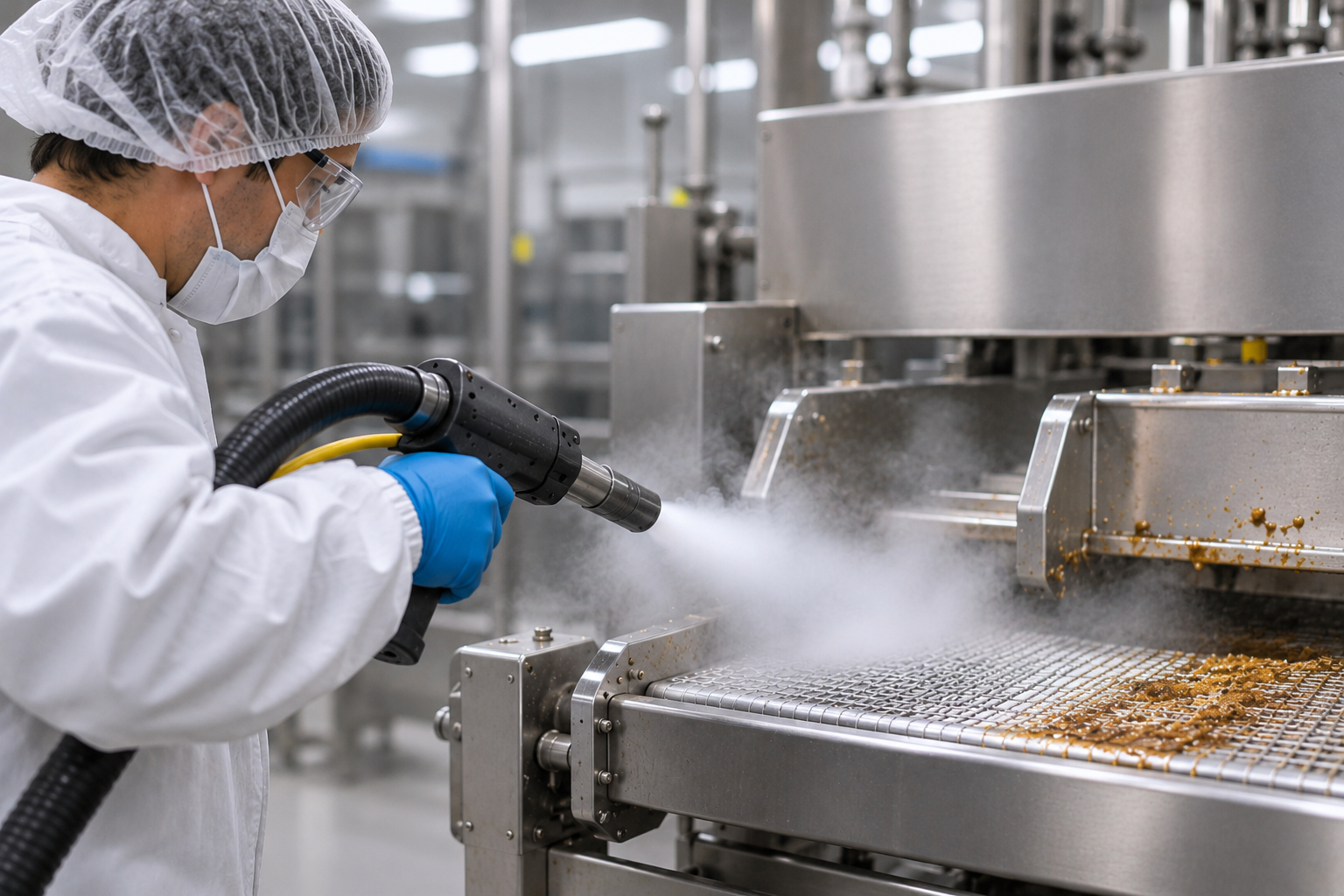
Whether dry ice blasting fits a food production programme depends on the type of equipment, cleaning frequency, hygiene standards and operational workflow. For many UK producers, a dry, chemical free method supports compliance whilst protecting machinery and shortening turnaround. Sentrex carries out a site assessment that aligns the cleaning method with compliance obligations, which helps reduce operational stress ahead of audits. The audit side is covered in Can Dry Ice Blasting Help a Food Site Pass a Hygiene Audit?.
Sentrex delivers dry ice blasting through local teams in Birmingham, Bolton, Bury, Rochdale, Stockport, Warrington and Leeds. For manufacturers with several plants, manufacturing group cleaning across multiple sites gives the same standard at each one. Sentrex’s food production cleaning and bakery and food processing facility cleaning services show how this fits a wider programme. To explore whether it suits your lines, contact us for a site assessment. For the fundamentals, read what dry ice blasting is and when manufacturers should use it.


