Liverpool’s architectural heritage spans Georgian elegance to contemporary glass towers. From the iconic waterfront structures around the Royal Albert Dock to modern commercial developments throughout the Baltic Triangle, building exteriors define how businesses present themselves. Sentrex provides drone cleaning services that maintain Liverpool’s diverse built environment without the disruption, cost, and safety risks traditional methods create.
Conventional access creates problems that drone technology solves. Scaffolding requires permits, blocks pavements, and forces businesses to operate around construction. Rope access exposes workers to height risks whilst limiting cleaning scope. Cherry pickers struggle in Liverpool’s narrow streets and require road closures that frustrate occupants. Drones eliminate these complications entirely.


Liverpool’s commercial property presents unique challenges. The Liver Building and Three Graces dominate the waterfront with structures designed long before modern access equipment existed. St George’s Hall’s neoclassical facade towers over surrounding streets with no convenient scaffold positions. The Metropolitan Cathedral rises above the Knowledge Quarter at angles unsuitable for standard equipment.
Georgian Quarter properties along Hope Street and Rodney Street feature period architecture requiring sympathetic maintenance. Damaging original stonework violates conservation requirements. Water penetration risks structural problems in buildings constructed before modern damp-proofing. Traditional pressure washing creates these exact problems.
The Ropewalks district repurposed nineteenth-century rope factories into creative spaces with challenging exteriors. Narrow cobbled streets prevent large vehicles positioning. Building owners value street art and architectural character that aggressive cleaning destroys. Standard methods prove incompatible.
Industrial operations around Speke, Garston, and Bootle operate continuously. Food manufacturers cannot halt production for facade cleaning. Logistics centres coordinating Port of Liverpool operations run twenty-four hours daily. Warehouse exteriors accumulate industrial contamination requiring removal without operational shutdown.
Liverpool ONE combines retail, residential, and leisure functions across multiple towers. Scaffolding blocking storefronts costs retailers revenue. Equipment restricting pedestrian flow annoys customers. Access platforms outside apartment windows upset residents. Shopping centres cannot afford extended disruption.
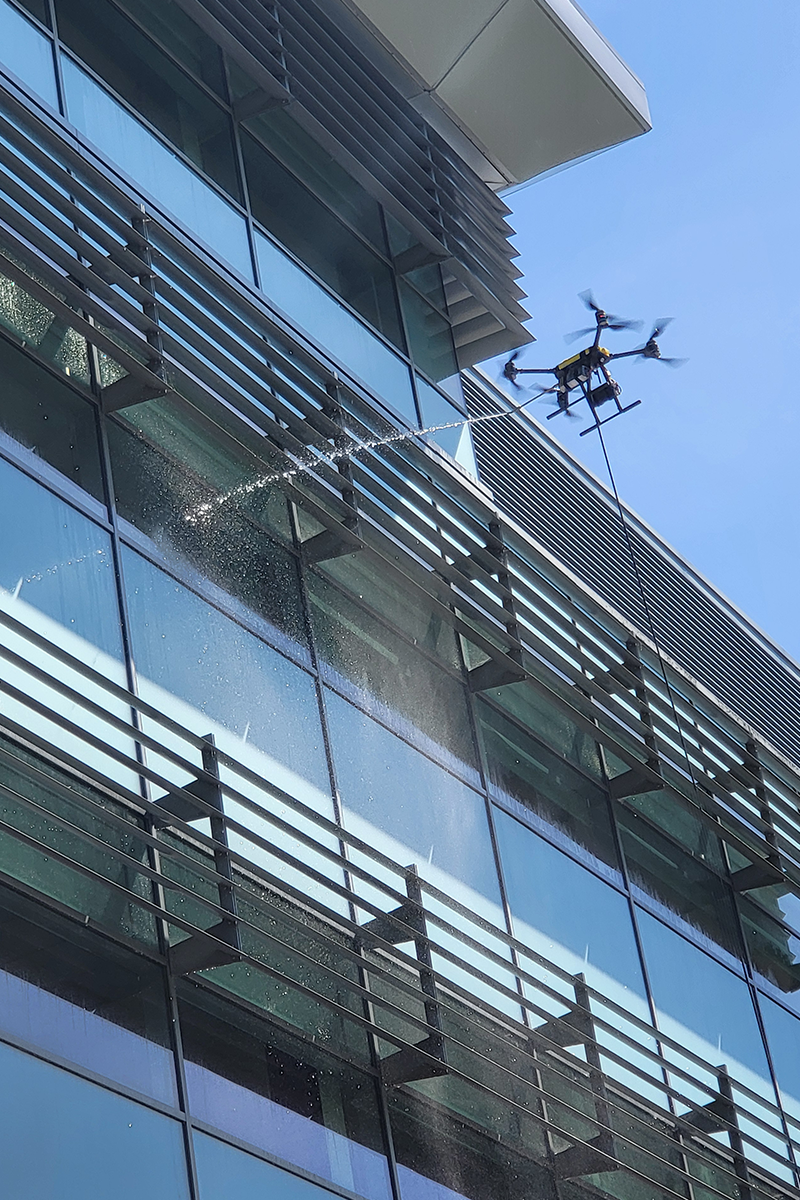
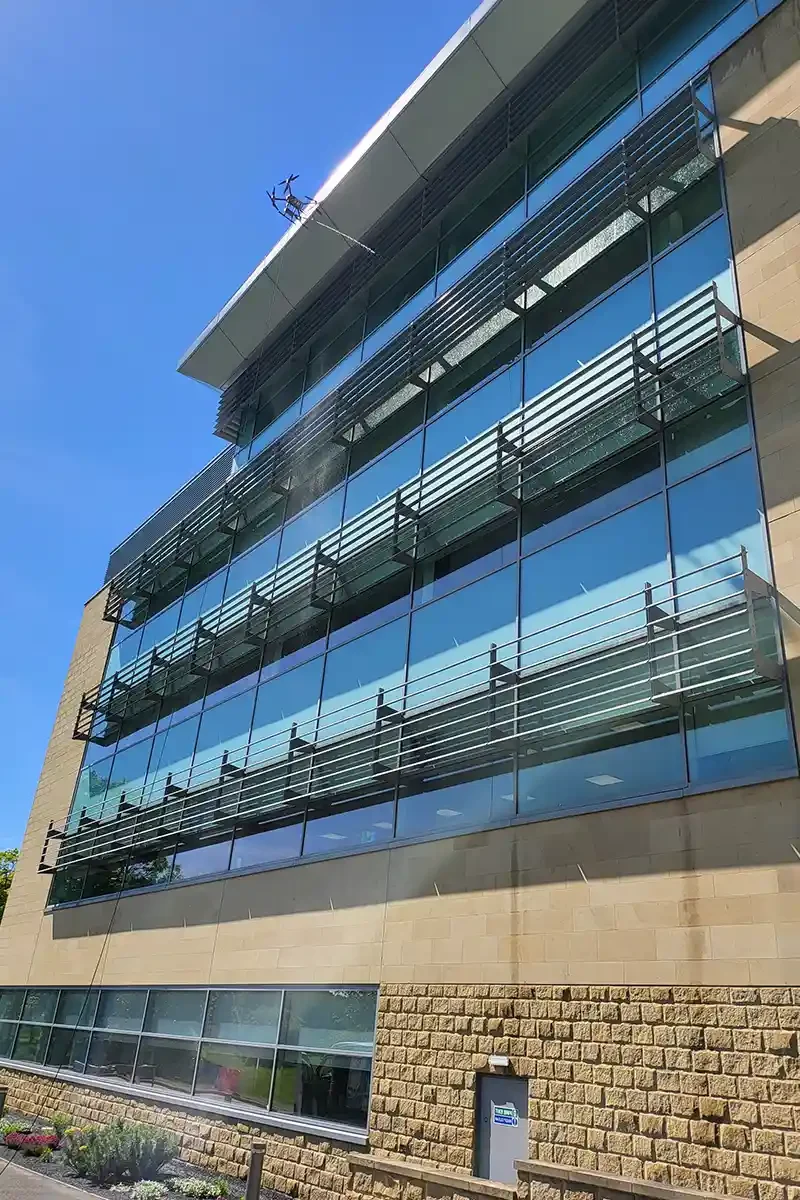
Drones reach any height whilst operators remain safely at ground level. Specialist cleaning attachments deliver solutions precisely to contaminated surfaces. Camera systems provide close inspection capability identifying defects invisible from ground level. Thermal imaging detects water ingress or insulation failure before problems escalate.
The operational advantage proves substantial. Projects complete overnight or across weekends. Pavements stay clear. Building entrances remain accessible. Retail premises trade normally. Office workers continue undisturbed. Car parks operate throughout. Residents experience minimal disruption beyond brief notification.
Safety transforms completely. No working at height eliminates the primary risk factor. No scaffolding assembly removes construction hazards. No rope access avoids suspended platform dangers. Risk assessments simplify dramatically. Insurance costs reflect genuinely lower exposure. Health and safety documentation reduces to manageable levels.
Cost benefits compound across multiple factors. No scaffolding hire. No street permits. No parking suspensions. No security measures around access equipment. Reduced project duration cuts labour costs. Faster completion means buildings return to full operation sooner. The financial case strengthens with project scale.
Waterfront properties near Pier Head and the Albert Dock face continuous contamination from River Mersey salt spray, seagull fouling, and industrial emissions. Glass facades on modern developments lose transparency. Historic stonework darkens with urban grime. Traditional cleaning either risks heritage fabric or costs excessively through scaffolding. Drone technology maintains presentation standards efficiently whilst preserving architectural integrity and uninterrupted river views.
Chinatown around Berry Street contains some of Liverpool’s most distinctive architecture. The ornate Chinese Arch and surrounding buildings feature decorative elements requiring careful maintenance. Urban pollution accumulates in carved details. Standard pressure washing damages delicate stonework. Drones clean precisely whilst protecting cultural significance.
The Baltic Triangle converted industrial warehouses into creative hubs with exteriors reflecting this heritage. Street art covers many buildings as valued cultural expression. Former factory structures feature high walls with restricted ground access. Cleaning must preserve character whilst removing genuine contamination. Drone operators distinguish between grime requiring removal and artwork worth protecting.
St George’s Quarter serves civic and cultural functions through the Walker Art Gallery, World Museum, Empire Theatre, and Liverpool Central Library. St George’s Hall’s Grade I listed stonework demands conservation-compliant maintenance. Visitors judge Liverpool by these landmark buildings. Traditional access methods disrupt cultural programming and block visitor approach. Drones maintain standards without operational impact.
Retail concentrations along Bold Street, Church Street, and throughout Liverpool ONE depend on visual appeal. Dirty facades signal neglect. Customers form negative judgments within seconds. Scaffolding blocking storefronts reduces footfall and revenue. Drone cleaning maintains appearance without trading disruption.
Office developments near Lime Street Station and throughout the commercial district around Castle Street and Dale Street house professional services firms. Building presentation reflects occupant quality. Tenants expect maintenance without disruption. Facade cleaning during business hours creates complaints. Traditional weekend work incurs premium rates. Drones clean efficiently outside office hours at standard costs.
Education facilities throughout Wavertree, Mossley Hill, and Edge Hill operate during term time with limited maintenance windows. Liverpool Cathedral and the Metropolitan Cathedral welcome visitors daily. Healthcare buildings treat patients continuously. Schools cannot erect scaffolding during term. Cathedrals avoid access equipment blocking worship or tourism. Hospitals need cleaning without patient disruption. Drone technology works around these constraints.
Industrial sites across Speke Industrial Estate, Garston Docks, and Bootle logistics centres require external maintenance supporting audit compliance. Food production facilities face hygiene inspections where external cleanliness demonstrates systematic standards. Pharmaceutical manufacturers maintain validated environments. Automotive component suppliers satisfy quality requirements. Warehouse exteriors signal operational professionalism to visiting clients. Drone cleaning delivers audit-ready presentation without production interference.
Residential developments throughout Aigburth, Childwall, Woolton, and Allerton contain occupied apartments where facade maintenance traditionally causes complaints. Scaffolding blocks light and views. Access platforms outside windows feel intrusive. Equipment noise disturbs residents. Projects extending weeks frustrate everyone. Drone cleaning completes rapidly with minimal resident impact.
Inspection capabilities add substantial value. High-resolution cameras examine building exteriors in detail operators cannot see from ground level. Cracked render, failing sealant, loose stonework, and deteriorating flashings become visible before causing expensive failures. Thermal imaging identifies water ingress or insulation gaps invisible to standard inspection.
Regular drone inspection supports predictive maintenance. Building managers identify problems early when intervention costs less. Insurance claims benefit from documented condition evidence. Planned maintenance replaces expensive emergency repairs. Facilities budgets perform better through informed decision-making.
Liverpool’s maritime climate accelerates building deterioration. Salt air corrodes metal fixings. Wind-driven rain penetrates defective seals. Regular inspection catches problems before weather causes serious damage. Documentation tracks building condition over time, demonstrating maintenance diligence to insurers and regulators.
External drone cleaning works most effectively alongside comprehensive internal maintenance. Our industrial cleaning in Liverpool services support manufacturing, logistics, and food production operations. Office cleaning in Liverpool maintains professional environments across the commercial district.
Single-source accountability simplifies supplier management. Coordinated scheduling ensures all maintenance aligns with operational requirements. Consistent standards apply across internal and external environments. Communication flows through established relationships rather than multiple contractor interfaces.
Understanding how drone cleaning saves time, money, and risk helps clients evaluate technology benefits accurately. Applications continue expanding as organisations discover surprising places drone cleaning is now being used across diverse Liverpool sectors.

Professional operation requires verified competence. Our accreditations include CHAS, Safe Contractor, ISO 9001, ISO 14001, and IPAF certification demonstrating systematic quality management and safety compliance. Operators hold Civil Aviation Authority permissions for commercial drone operations. Insurance covers specialist equipment, public liability, and professional indemnity.
Every project begins with thorough risk assessment. Method statements detail safe working procedures specific to site conditions. Communication plans coordinate with building occupants and surrounding businesses. Documentation satisfies client audit requirements and regulatory obligations whilst remaining accessible rather than bureaucratic.
Our About Us approach emphasises responsive service and transparent communication. Liverpool clients receive local support understanding regional building challenges and operational requirements. Projects coordinate around business schedules, working nights, weekends, or shutdown periods as needed. Teams mobilise rapidly for urgent requirements.
Liverpool businesses seeking efficient, safe, cost-effective external maintenance should evaluate drone cleaning advantages against traditional access methods.
Contact us to discuss specific building requirements. Call 0333 240 1145 or message through our website. Our Liverpool team understands local architectural challenges and delivers solutions that work commercially.
We’re ready to demonstrate how drone technology maintains Liverpool’s diverse built environment without the disruption, risk, and unnecessary expense traditional methods create.
