
Drone cleaning services are starting to be integrated successfully for various commercial cleaning needs. But is it economical? Or is it all just a big risk?
In this blog, we will share how drone cleaning saves time, money, and risk.
Sentrex Services stands as a leading provider of comprehensive cleaning and hygiene solutions, serving a vast region from the Northwest to the Southeast of England. With a dedicated team of over 600 professionals, we deliver bespoke cleaning services tailored to the unique needs of each commercial client.
Unknown facts about drone cleaning
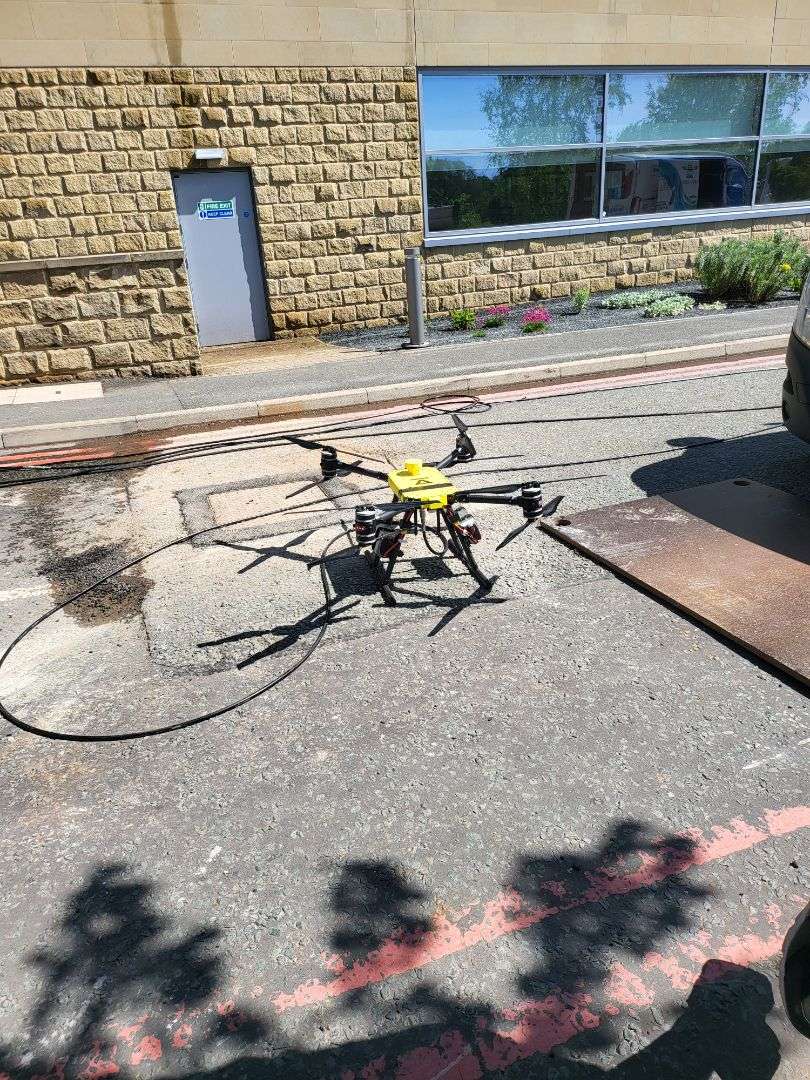
Drone specific chemicals became a necessity
Traditional industrial cleaning detergents are designed to sit on a surface for a long dwell time (time to soak) and require manual scrubbing/agitation.
New, highly concentrated, fast-acting cleaning solutions have been developed specifically for drones. Since a drone can only hover and spray a limited amount of liquid, the chemicals must act almost instantly on the dirt and rinse away cleanly to avoid streaks, often leaving a protective, dirt-resistant film.
Cleaning drones aren’t always free flying
People imagine a fully autonomous drone flying with a large tank of water. The truth is that this isn’t always the case.
Most powerful commercial cleaning drones are tethered to a ground unit by a specialised, lightweight hose. This solves two massive problems:
- Unlimited water/chemical supply: The drone doesn’t need to carry the heavy fluid tank, allowing it to be smaller and more manoeuvrable.
- Extended flight time: By only carrying batteries for the rotors, not the payload, the operational flight time is significantly extended beyond the typical 15-30 minute limit of battery-only drones.
More than one person is needed
People often believe drone cleaning is a one-person job because the pilot is on the ground. The fact is that professional drone operations often require a team for safety and efficiency. They generally are:
- The Pilot: Operates the drone and the spray system.
- The Visual Observer (VO) / Spotter: Crucial for safety, the spotter watches the surrounding airspace, checks for obstacles (like birds or balconies), and monitors the public area below.
- The Ground Unit Manager: Manages the chemical mixing, water supply, hose tension, and battery swaps/charging.
It’s a solution for buildings without safety anchors
Drone cleaning is a game-changer for older commercial buildings, schools, and hospitals that lack modern rooftop safety anchor systems (required for rappelling window cleaners).
Installing these anchor systems can be extremely expensive and disruptive. Drones provide a safe, compliant, and cost-effective alternative for routine maintenance on these structures, where traditional methods were logistically prohibitive.
They are used for cleaning more than just windows
Beyond windows and facades, cleaning drones are being used for:
- Solar Panel Washing: They safely and quickly clean large arrays, which is crucial for maintaining energy efficiency.
- Stadium Roofs and Canopies: Reaching the extremely high, complex, and curved surfaces of large sports venues.
- Graffiti Removal and Rust Prevention: Some high-power drones can apply protective coatings or specialised rust removal chemicals to industrial infrastructure like bridges or oil tanks.
How using drones for cleaning can save time, money, and risk
How it saves time
Whether it’s to observe areas that need to be cleaned, or actual cleaning, using drones will save time that would usually be spent setting up apparatus. Cranes, safety equipment and other mitigations can increase the time it takes to clean, whilst using a drone handles it swiftly.
Drones can be deployed, calibrated, and ready to fly in under an hour. Drones can move over large, uniform surfaces like glass or cladding much faster and more consistently than a human crew descending on ropes. They can clean vast areas with a fraction of the labour.
The cleaning process is faster and quieter, meaning less operational disruption for tenants, hotel guests, or business employees. Businesses can resume normal operations more quickly.
How it saves money
The lack of equipment such as cranes and reduced manpower means a much smaller financial cost for the same kind of work.
The cost of scaffolding or crane rental for a single project often dwarfs the operational cost of drone deployment. This elimination of heavy equipment rental provides immediate savings.
Advanced drone systems use precision spraying and GPS-guided flight paths. This leads to significantly lower consumption of water and cleaning chemicals (up to 60-80% less water in some cases) compared to manual methods, further reducing operating expenses.
Some drones can integrate thermal imaging to spot defects, leaks, or solar panel efficiency losses while cleaning, turning the process into a combined maintenance inspection. Although these are rarer.
How it reduces risk
Due to the fact that essentially one person is needed to operate the drone, there are fewer chances for people to get hurt. This is only a concern if cleaning is taking place amongst people in or outside the building.
By eliminating the need for workers to climb or be suspended, facility owners and cleaning companies see a substantial drop in liability and the associated insurance premiums for high-risk work.
Traditional scaffolding and lifts pose a risk to the public from falling tools, materials, or equipment. Drone operations require a smaller, more easily managed ground exclusion zone, and there are no heavy, temporary structures to worry about.
Are there risks to using drones for cleaning?
Of course, like with any method, risks are a constant consideration, but can be mitigated with proper care, attention, and following established regulations. Below are the common risks associated with drone operated cleaning.
Collision & falling
The primary concern is the risk of the drone itself losing control and crashing onto people, property, or traffic below.
The main risk is the potential for a catastrophic failure (e.g., motor failure, propeller detachment, or loss of signal). Because these are heavy-duty, water-carrying drones, a fall from a high altitude poses a major hazard.
Despite obstacle avoidance systems, a drone could collide with a building, causing property damage, especially to sensitive elements like windows, seals, or architectural features.
Cleaning drones are tethered to a ground unit for water/chemicals and often carry high-pressure washing gear. If the drone were to drop this equipment or the hose became snagged, it could injure people or damage property.
Regulations
Drone operations are highly regulated, and non-compliance can lead to massive fines and grounding of the operation.
Operating near airports, government buildings, or in densely populated urban areas often requires complex and time-consuming permits or waivers from aviation authorities (like the CAA).
Most regulations require the pilot or a visual observer to maintain a continuous visual line of sight with the drone. This becomes extremely challenging when cleaning very tall skyscrapers (Beyond Visual Line of Sight – BVLOS), requiring special waivers that are difficult to obtain.
Many regulatory bodies have a maximum take-off weight (MTOW) that drones must adhere to. Cleaning drones, especially when carrying water and equipment, can easily exceed these limits, requiring special permissions.
Inquire for drone cleaning with Sentrex
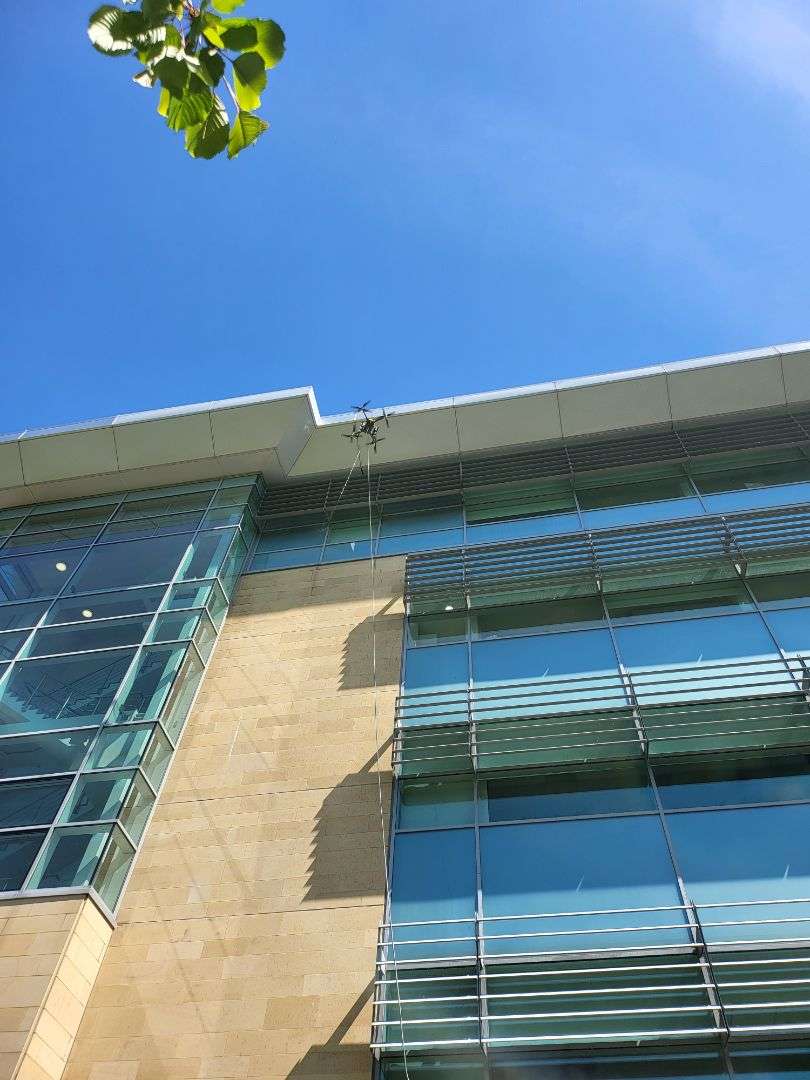
At Sentrex, we prioritise commercial, industrial, and specialist cleaning services. Our services aren’t just a standard once-over, we ensure a comprehensive and individually tailored approach perfect for any site.
Our services are tailored to you, that means you will know everything that you are paying for beforehand.
Here is a list of some of the many services we provide:
- Chemical degreasing
- Steam cleaning
- Pressure washing
- Commercial carpet cleaning
- Trash clean-up
- Window cleaning
- Exterior cleaning
- Deep cleaning
In this blog, we hope to have provided valuable information by highlighting how drone cleaning saves time, money and risk.
Our commitment to fair pricing, environmental sustainability, and personalised service sets us apart. We prioritise quality through rigorous control measures, including monthly audits with advanced software, real-time management via iPads, and an automated time and attendance system.
As members of esteemed trade bodies, we adhere to the highest industry standards. Beyond core cleaning, we offer a full suite of soft and hard FM services, ensuring comprehensive building maintenance. Want to know if our services apply to your business or site? Don’t hesitate to get in touch with us to secure a superior clean.


