
There are structures that conventional cleaning methods simply cannot service effectively. Rooftops that require weeks of scaffolding to access. Facades where abseiling teams face unacceptable risk. Industrial canopies where working at height exposes operatives to conditions that no risk assessment can make fully safe. For years, facilities managers and property owners in these situations faced a choice between inadequate cleaning, prohibitive cost, and serious safety exposure. Drone cleaning has changed that calculation entirely. The results it delivers, across safety, speed, cost, and cleaning quality, are redefining what is achievable on structures that were previously considered too difficult or too dangerous to maintain properly.
What Makes Drone Cleaning Results Different
The outcomes that drone cleaning services produce are not simply a variation on what traditional methods achieve. They are categorically different in several respects. The absence of working at height removes a class of risk that has historically defined the limits of what cleaning is practical on tall or complex structures. The precision of drone delivery means that cleaning agents reach surfaces that operatives on ropes or platforms could not safely access. And the speed of deployment means that structures can be cleaned without the extended disruption that scaffolding erection and dismantling imposes on a live site.
Understanding how drone cleaning saves time, money and risk gives broader context to why these results matter to the businesses and facilities that commission them. The five examples below illustrate what that difference looks like in practice.
Result 1: A Large Industrial Roof Cleaned Without a Single Operative Working at Height
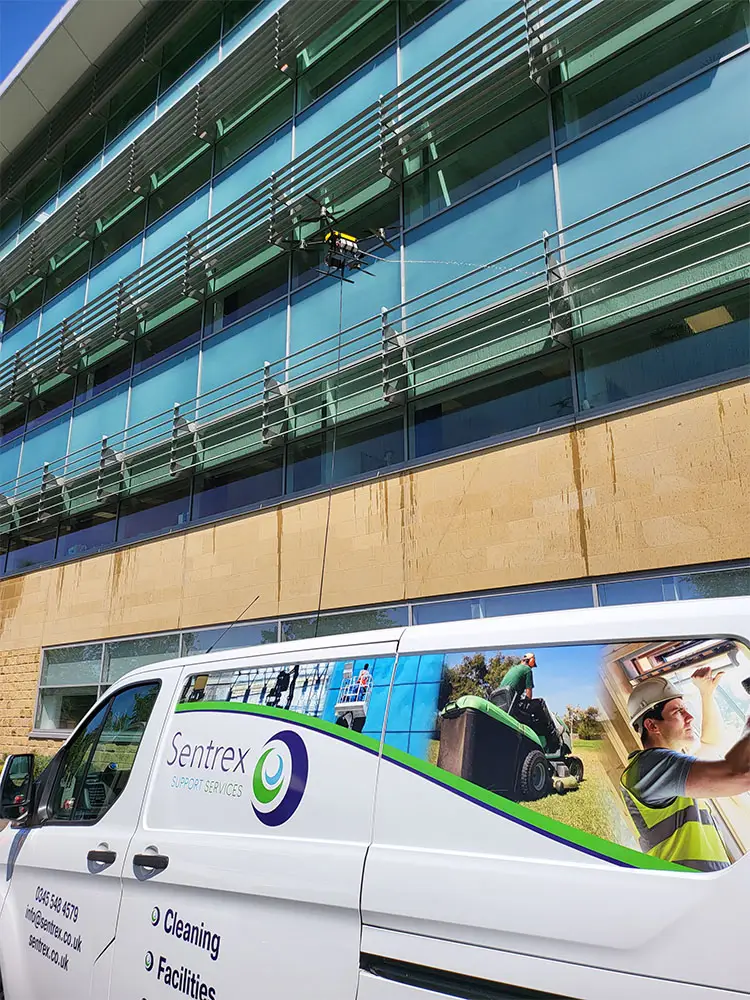
A large distribution facility with a multi span industrial roof had accumulated years of biological growth, debris, and contamination across its upper surfaces. The roof profile, which included multiple ridges, valleys, and roof mounted equipment housings, made conventional access both complex and costly. A full scaffold would have taken weeks to erect and would have required partial closure of the loading areas below throughout the clean.
The drone operation completed the full roof clean in a fraction of the time a scaffold based programme would have required, with operatives remaining at ground level throughout. No loading bay closures were necessary. The biological growth was cleared systematically across the full surface, including the areas around equipment housings that would have been the most difficult and expensive to reach by conventional means. The facility returned to normal operations the same day.
This is the result that matters most to operations directors managing large sites: a cleaning outcome that does not cost the business its operational continuity to achieve.
Result 2: A Heritage Facade Cleaned Without Damage or Disruption
A commercial building with an ornate stone facade in a busy town centre had not been properly cleaned for a significant period. The biological staining and atmospheric soiling had reached a point where it was affecting the appearance and the perception of the businesses operating from the building. The options considered before drone cleaning included cherry picker access, which was impractical given the street width, and abseiling, which carried both safety and reputational concerns in a high visibility public setting.
The drone clean was completed with a precision and control that matched the sensitivity the facade required. Cleaning pressure and agent concentration were adjusted in real time to suit the condition of the stonework at different points across the elevation. The result was a facade returned to its original appearance without any physical contact with the surface from operatives working at height, and without the road or pavement closures that other access methods would have required.
The surprising range of environments where drone cleaning is now being deployed reflects exactly this kind of application, where the method is not simply more convenient than the alternative but is the only realistic option for the environment and the structure involved.
Result 3: A Solar Panel Array Restored to Full Generation Efficiency
A commercial solar installation covering a significant area of a warehouse roof had seen its generation output decline noticeably over an eighteen month period. Inspection confirmed that soiling accumulation across the panel surfaces was the primary cause. The array layout and roof pitch made ground level access impossible and conventional cleaning impractical without the risk of panel damage from operative weight.
The drone operation cleaned the full array systematically, working across the panel surfaces with controlled fluid delivery that removed soiling without any mechanical contact. Post clean monitoring showed generation output recover to near the original specification. The cost of the drone clean was a small fraction of the generation loss the array would have continued to accumulate had the soiling remained unaddressed.
This result matters because it demonstrates something important about drone cleaning beyond the safety argument: it is often the only method capable of accessing and servicing a structure in the way that structure needs to be serviced, not just the safest or cheapest option among several.
Result 4: A Multi-Storey Car Park Facade Cleared of Years of Biological Growth
A multi storey car park in a city centre location had significant biological growth across its external concrete elevations. The growth had been present for long enough that it had begun to affect the structural surface, with moisture retention from the organic matter accelerating the weathering process. The exposed height of the structure and the limited access from surrounding streets made conventional cleaning methods either impractical or disproportionately expensive.
The drone programme cleared the full elevation systematically, applying appropriate biocidal treatment at consistent coverage across the full surface area. The operation worked around the car park’s operating hours, with no requirement to close the facility or restrict access at any point. Structural surveys following the clean confirmed that the biological matter had been fully removed and that the surface was in a condition to receive protective treatment to slow future growth.
At Sentrex, our operatives are trained and monitored to the standards that work on structures of this complexity demands. Our staff training programmes and cleaning staff monitoring processes ensure that the quality of delivery matches the quality of the technology being deployed.
Result 5: An Industrial Chimney Stack Cleaned and Inspected in a Single Visit

A disused industrial chimney stack on a brownfield redevelopment site required both cleaning and condition assessment as part of the planning process for the site’s redevelopment. The height of the structure made any conventional access method a significant undertaking in terms of both cost and programme time. A scaffold to full stack height would have taken weeks and represented a cost that was disproportionate to the work being done.
The drone operation completed cleaning of the full stack exterior and captured high resolution imagery of the surface condition in a single visit. The imagery provided the project team with the condition data they needed for the structural assessment, eliminating the need for a separate inspection programme. The combined cleaning and inspection outcome was delivered in a day, against a conventional programme that would have taken weeks.
This is the dimension of drone cleaning that is least discussed but perhaps most valuable to the clients who need it: the ability to combine cleaning with inspection in a single deployment, generating a record of surface condition alongside the cleaning outcome.
The Consistent Themes Across These Results
Looking across these five examples, several patterns emerge that define what drone cleaning consistently delivers:
- Structures that were either impractical or prohibitively expensive to clean by conventional means were brought to a proper maintenance standard
- Operational disruption was reduced to a minimum in every case, with facilities remaining in use throughout the cleaning programme
- Safety exposure was eliminated or reduced to a level that conventional methods could not have achieved
- Cleaning quality reached areas and surface conditions that working at height access would have either missed or damaged
These are not outcomes that depend on a particular type of structure or a particular sector. They reflect the fundamental characteristics of the method: precision, reach, and the removal of working at height as a constraint on what is achievable.
Sentrex’s approach to drone cleaning is underpinned by the same standards that run through all of our service delivery. Our accreditations reflect a commitment to compliance and quality, our eco-friendly cleaning services extend to the products and methods we deploy from drone platforms, and our gangmasters licensing ensures that our workforce operates within a framework of ethical and regulatory compliance at every level. If you have a structure that conventional cleaning has not been able to address, or if you would like to understand what drone cleaning could achieve on your site, get in touch with the team.


